
Leo's Blast
A.I. takes its first real hit from a higher power

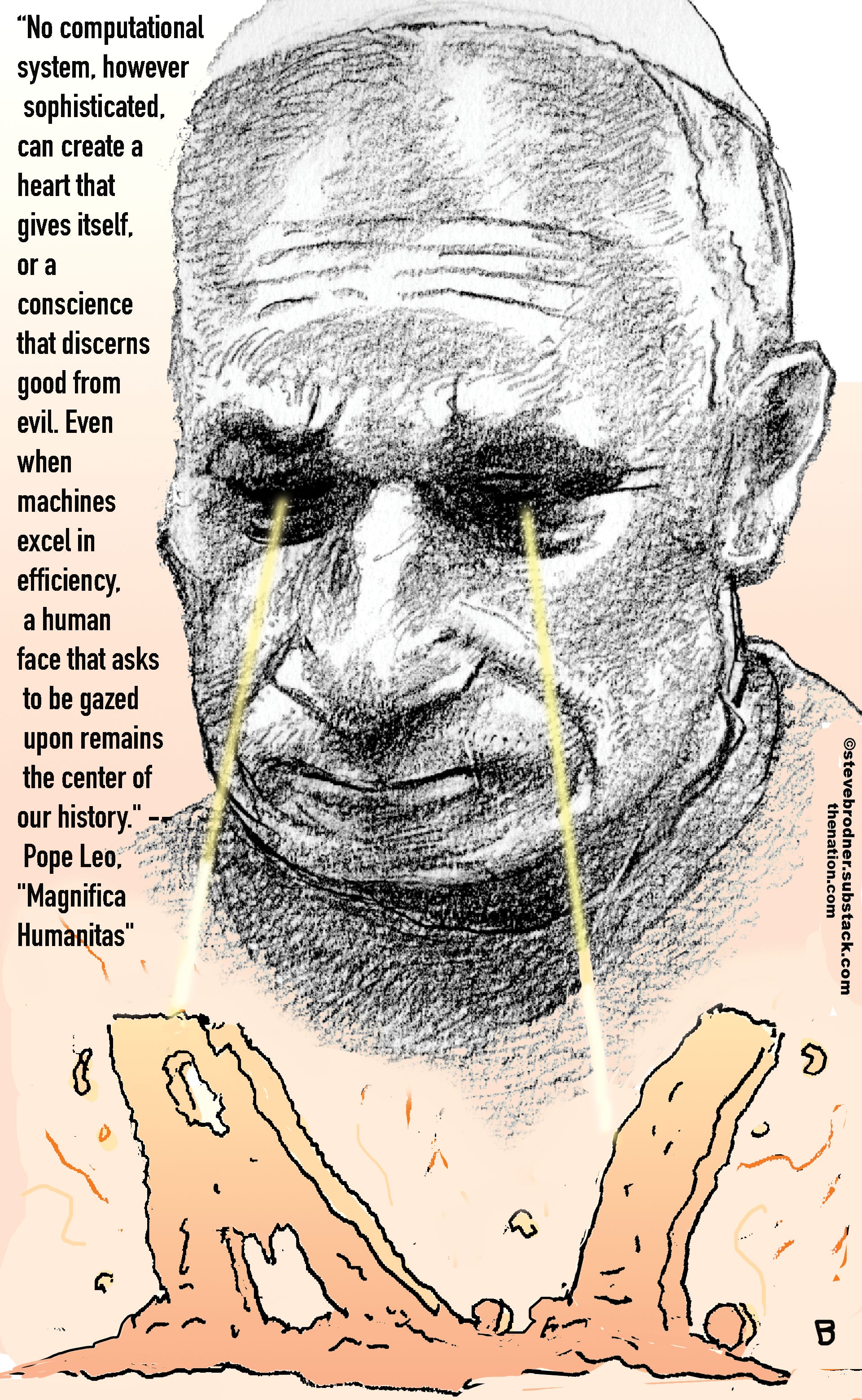
Pope Leo’s encyclical on AI is a blast of fresh air into a stale room full of rotting tropes. For the first time, this revolution, mounted by about eight soon-to-be trillionaires, currently terrifying the world with its uncontrolled expansion into every aspect of human endeavor, has been challenged on the battlefield of morality. Sadly, for them, as there is no moral foundation in AI, there is no moral defense.
For the Pope, there no financial reward that matches the concern for humanity.
Here are some quotes from the document:
1. “Like the natural environment, the ‘digital ecosystem’ can be preserved or exploited, shared or monopolized. Solidarity demands that decisions regarding data, algorithms, platforms and artificial intelligence take into account not only the immediate benefit for a few, but also the impact on all peoples and on future generations” (paragraph 76).
2. “In one sense, technological innovation can represent human participation in the divine act of creation. Developers, therefore, bear a particular ethical and spiritual responsibility, for every design choice reflects a vision of humanity” (paragraph 111).
3. “For an algorithm, an error is a flaw to be corrected; for a person, however, an error can be a catalyst for profound change” (paragraph 128).
4. “Those who control digital platforms and means of communication have a considerable ability to affect the collective imagination and to present a particular vision of reality as desirable. Such power should be constantly guided by the pursuit of truth and respect for human dignity, so that the culture fostered on the internet does not become an instrument of excessive distraction, homogenization or dominance, but rather a setting in which inner freedom and critical thought can mature” (paragraph 136).
5. “Our first task is neither to demonize nor idolize technological tools, but to utilize them on the basis of a fundamental principle, namely that truth is a common good and not the property of those with power or influence. We must therefore promote an ecology of communication” (paragraph 137).
6. “We must learn, then, how to exercise restraint in the use of AI and to protect our young people from the promise of the perfect machine, from that subtle temptation which renders human thought seemingly superfluous precisely when it is most needed” (paragraph 140).
7. “In the short term, it may seem advantageous to reduce labor costs or maximize financial efficiency, but in the long term this undermines the very foundations of social coexistence. While technological successes are celebrated, the social fabric is progressively eroded, as if by a silent virus” (paragraph 166).
8. “No algorithm can make war morally acceptable. AI does not remove the intrinsic inhumanity of conflict; indeed it can only bring about conflict more quickly and render it more impersonal, lowering the threshold for resorting to violence, transforming defense into threat prediction and thus reducing victims to data” (paragraph 198).
9. “Even in the darkest nights, the Lord raises up men and women who refuse to give up, who persevere in doing good, who protect the vulnerable and open pathways to reconciliation. The memory of the saints, righteous people and the oft-forgotten peacemakers, show us that grace does not magically eliminate conflict, but instead it inspires active resistance to evil and an astonishing creativity in doing good” (paragraph 211).
10. “We all need to learn how to engage with the digital world in a human way, as an integral part of our education in the faith and in a life lived according to the Gospel. Indeed, we must consider the digital world as a new continent to be evangelized, one that requires generous missionaries who are mature in the faith” (paragraph 238).
More soon,
Steve
This past weekend, my wife and I drove to Walla Walla in eastern Washington state. Along the drive on Interstate 84 and on highway 82, one can see the massive data centers along the Columbia River. There's one in The Dalles, Oregon. There's a bunch of them in Hermiston, Oregon and some between Hermiston and Walla Walla. One in Hermiston was located right next to a low income area and across the road from a Nature preserve.
Local aquifers, that are important to the farming and wine growing in this region, are being poisoned and dried up. (https://whitmanwire.com/news/2026/05/01/washington-declares-statewide-drought/) Also data centers are massively draining water from the Columbia River, a river which supplies water to both states and much of the hydro power of the Pacific Northwest. These regions of Oregon and Washington are, of course, Republican controlled and the local politicians were totally conned by Amazon and Meta with false promises of jobs and local economic improvement.
However, one bright spot has arisen from this. Most of the citizens, no matter what their politics, have become aware of the damage that these places are doing and are pretty upset at being sold out by their elected reps.
Hopefully, they're pissed enough to take action against the Techbroligarchy in November.
So . . .
Where there ought to have been oversight of industry provided by the United States Congress and government agencies - we have an American Pope.
And where there should have been the United States Senate providing oversight of the departments of State and of Defense - we have the Gulf States threatening to stop the flow of monies to Trump Inc. in order to get Trump to take the off ramp negotiated by Pakistan - which if we're lucky might get us close to Obama's nuclear deal.
And where there ought to be the United States Supreme Court providing a balance of powers and preventing Executive overreach - there is only the American electorate with a chance of reining in Trump and his GOP. If the Hungarian opposition could unite to take down Orban, then we should be able to Vote Blue No Matter Who - and make a true lame duck out the Republican craven sluck.